WHAT IS ART ? Art is something we do, a verb. Art is an expression of our thoughts, emotions, intuitions, and desires, but it is even more personal than that: it’s about sharing the way we experience the world, which for many is an extension of personality. It is the communication of intimate concepts that cannot be faithfully portrayed by words alone. And because words alone are not enough, we must find some other vehicle to carry our intent. But the content that we instill on or in our chosen media is not in itself the art. Art is to be found in how the media is used, the way in which the content is expressed. Art’ is where we make meaning beyond language. Because what art expresses and evokes is in part ineffable , we find it difficult to define and delineate it. It is known through the experience of the audience as well as the intention and expression of the artist. The meaning is made by all the participants, and so can never be fully known. It is multifarious and on-g...
Posts
POST IMPRESSIONISM
- Get link
- X
- Other Apps
VINCENT VAN GOGH (1853-1890) 'View of Arles-Orchard in Bloom with Poplars', 1890 (oil on canvas) Post Impressionism was not a formal movement or style. The Post Impressionists were a few independent artists at the end of the 19th century who rebelled against the limitations of Impressionism. They developed a range of personal styles that focused on the emotional, structural, symbolic and spiritual elements that they felt were missing from Impressionism. Their combined contributions form the artistic roots of modern art for the next eighty years. Impressionism was the first movement in the canon of modern art. Like most revolutionary styles it was gradually absorbed into the mainstream and its limitations became frustrating to the succeeding generation. Artists such as Vincent Van Gogh, Paul Cézanne, Paul Gauguin and Georges Seurat, although steeped in the traditions of Impressionism, pushed the boundaries of the style in different creative directions and in doing so laid the ...
IMPRESSIONISM
- Get link
- X
- Other Apps
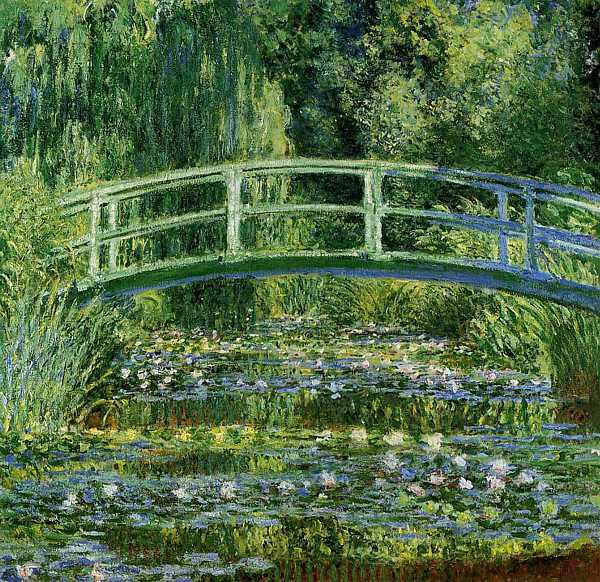
CLAUDE MONET (1840-1926) 'Waterlilies and Japanese Bridge', 1899 (oil on canvas) Impressionism was an art movement in France at the end of the 19th century. The Impressionists were a group of artists renowned for their innovative painting techniques and approach to using color in art. Their paintings became the most popular art form of the 20th century with the public and collectors alike. The Impressionist Artists ALFRED SISLEY (1839-99) 'Flood at Port Marley', 1876 (oil on canvas) Many artists contributed to the first exhibition of French Impressionist painting in 1874 but Claude Monet (1840-1926), Pierre Auguste Renoir (1841-1919), Camille Pissarro (1831-1903), Edgar Degas (1834-1917), Alfred Sisley (1839-99) and Henri Marie Raymond de Toulouse-Lautrec (1864-1901) were the main figures who formed the backbone of the movement. Impressionist Painting Technique CLAUDE MONET (1840-1926) 'Wheatstacks - End of Summer', 1890-91 (oil on canvas) The Impressionists...
- Get link
- X
- Other Apps
THE HIGH RENAISSANCE LEONARDO DA VINCI 1452-1519) 'Mona Lisa', c.1503-06 (oil on panel) The High Renaissance relocated to Rome which became the cultural capital of the movement under the generous patronage of successive popes. Giorgio Vasari writes about this period (which he calls the 'third manner') as the highest peak of artistic achievement in which Renaissance art reached an unsurpassed level of grandeur. Some individual artists and their patrons also gained recognition for their local regions in Central Italy through the creation of significant artworks. RAPHAEL SANZIO (1483-1520) 'The Transfiguration', 1516-20 (egg tempera on a poplar panel) The path to realism in art reached its peak in the sixteenth century with Leonardo, Michelangelo and Raphael who achieved the classical ideals that artists had pursued since the Proto-Renaissance. The general character of this art was classical and intellectual in its concept, focusing on ideas relating to the str...
- Get link
- X
- Other Apps
The Early Renaissance The Early Renaissance is mainly associated with the city of Florence as the birthplace of the movement and as its main centre of artistic innovation. Early Renaissance art introduces a greater degree of naturalism by placing an emphasis on the observational drawing of the human figure. It also establishes a more precise spatial organization of the figures, buildings and landscapes through the invention of perspective drawing. Humanistic subject matter, based on the study of Classical mythology , along with portraiture and landscape evolved as acceptable subjects for art during The Early Renaissance. This marks a shift from the exclusive position held by religious art. Some artists, for example Masaccio, Fra Angelico and Piero della Francesca, followed in the footsteps of Giotto by increasing the degree of naturalism in painting within the traditional themes of Christian art. Others, such as Paolo Uccello and Sandro Botticelli , advanced the same aesthetic i...
- Get link
- X
- Other Apps
The Proto Renaissance The Proto Renaissance is the name given to that uncertain period of transition in Italian art as the creative influence of the Byzantine tradition began to decline. Artists saw the need for a more relevant art form that reflected the aspirations of an ambitious Italy, desperate to emerge from the stagnation of its medieval past. During the Proto Renaissance, there was a gradual development of naturalism in Italian art which was inspired by the values of Classical humanism and the anatomical beauty of Classical sculpture. You can see the start of this process when you compare two paintings by Duccio di Buonninsegna and Giotto di Bondone . In Duccio's 'Maestà ', the huge altarpiece that he painted for Siena Cathedral , the artist still has one foot stuck in the flat frontal conventions of Byzantine composition. The other tries to free itself through the greater naturalism of the figures, as they turn to focus on the Christ child or, in a few distr...
- Get link
- X
- Other Apps
ITALIAN RENAISSANCE ART The Italian Renaissance was a 'rebirth' of Classical values in art, literature and philosophy. It was a period of artistic development in Western Art that stretched from the revival of naturalism in the art of Giotto at the end of the 13th century to the expressive forms of Mannerism in the art of Michelangelo at the start of the 16th century. Its influence spread across Europe and gave rise to the cultural and scientific ideas that shaped artistic thought for the next five hundred years. The term 'Renaissance', which means 'rebirth' in French, was coined in 1855 by Jules Michelet in his nineteen-volume masterpiece 'Histoire de France' . The Key Elements of Italian Renaissance Art Naturalism : A search for the perfection of form that was inspired by the naturalism of Classical sculpture. Humanism : The influence of the philosophy of Classical humanism which is revealed in the gradual shift from religious to secular subjec...
- Get link
- X
- Other Apps
ART MOVEMENTS : ARTISTIC STYLES , TECHNIQUES & IDEAS What is an Art Movement ? An Art Movement is a distinct artistic style , technique, or trend that maps a particular period of cultural development in the history of art. There is no fixed rule that determines what constitutes an art movement. The artists associated with one movement may adhere to strict guiding principles, whereas those who belong to another may have little in common. Art Movements are simply a historical convenience for grouping together artists of a certain period or style so that they may be understood within a specific context. Art Movements are usually named retrospectively by art critics or historians and their titles are often witty or sarcastic nicknames pulled from a bad review. Grouping artists of similar interests or styles into Art Movements is mainly a characteristic of Western Art . Art Movements are essentially a 20th century development when there was a greater variety of styles ...